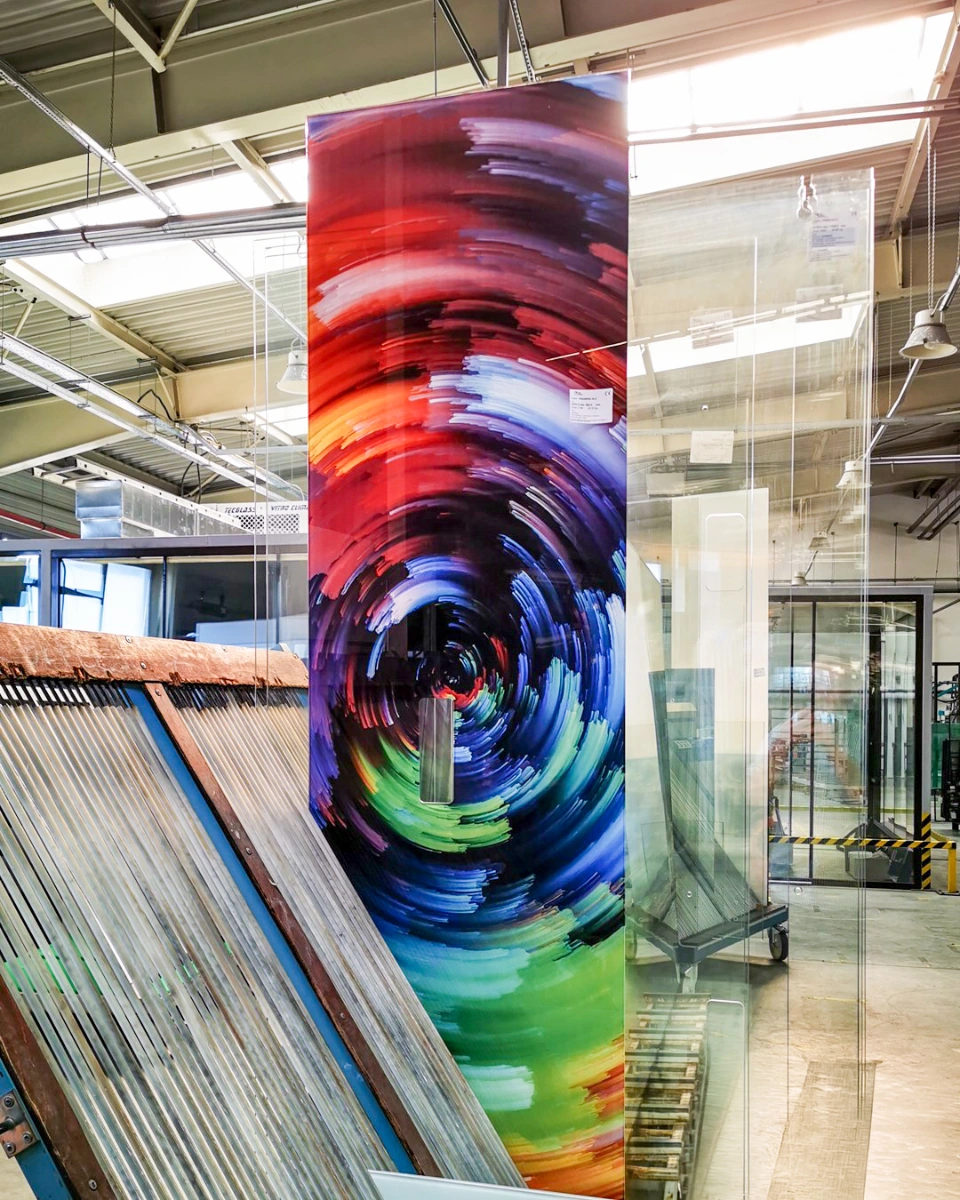
If you want a glass finish that lasts for decades without fading, scratching, or peeling, ceramic printing is the solution — the color fuses with the glass at high temperature, becoming part of the material rather than a layer applied on top. Decorative film and sandblasting are cheaper and faster to apply, but they remain surface-level solutions, with a limited lifespan, especially outdoors or in high-traffic areas.
The choice between the two isn’t just about budget — it’s about where the finish will be used and how long you need it to look good. For a temporary project or a tight budget, film may be enough. For a facade, a commercial cladding surface, or a kitchen countertop used every day, durability matters far more than the initial price difference.
What ceramic printing actually does
Digital ceramic printing doesn’t put color on glass — it “burns” it in. The ink is applied through a digital print head, and during tempering (when the glass is heated to high temperatures and rapidly cooled), the pigment fuses with the surface. The color becomes part of the glass, not a layer on top that can scratch, peel, or fade over time.
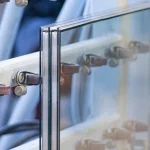
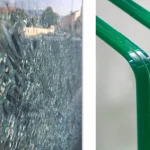
The practical result: UV resistance without fading, scratch resistance identical to standard toughened glass, and durability that doesn’t depend on application quality, unlike a manually applied film — which is why ceramic printing is the natural choice for any exposed surface: facades, exterior cladding, balustrade panels, or kitchen surfaces used daily.
On our digital printing line, we work at high resolution, in jumbo format (up to 4,000×2,500 mm), covering both large facade panels and individual pieces, with no minimum order and no tooling or template costs — a significant advantage over traditional printing technologies, where small orders are either impossible or very expensive.
What decorative film and sandblasting are
Decorative film is an adhesive layer applied to the glass surface, available in a wide range of patterns and textures. Its main advantage is lower cost and speed — it can be applied directly to existing glass, with no additional heat processing. The drawback shows up over time: exposed to sun, film can fade or stiffen, and under heavy handling, edges can start to peel.
Sandblasting is a mechanical process — the glass surface is blasted with pressurized sand, creating a permanent, opaque, matte finish, because it physically alters the glass texture rather than adding a layer on top. It’s more durable than film, but only offers monochrome, matte results, with no ability to reproduce colors, images, or complex patterns.
Direct comparison: durability, cost, appearance
On durability, ceramic printing clearly wins — it doesn’t fade, scratch, or peel, because it’s part of the glass itself. Film has a limited lifespan, especially outdoors, and sandblasting, while physically durable, offers no design flexibility.
On cost, film and sandblasting are usually cheaper for small orders, especially for simple, monochrome projects. Ceramic printing has a higher upfront cost per square meter, but it eliminates the cost of periodic replacement — a film that degrades within a few years and needs replacing ends up costing more over the long run than a one-time investment in ceramic printing.
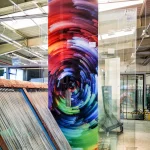
On appearance, ceramic printing offers the greatest freedom — unlimited colors, gradients, images, text, logos, with image quality comparable to standard digital printing, but permanent. Film covers a good range of predefined patterns. Sandblasting stays limited to a uniform matte look, with no color variation.
High-durability solutions for commercial cladding and custom kitchen countertops
For projects where durability matters most — facade cladding, commercial decorative panels exposed to sun and weather, or kitchen countertops used daily and exposed to heat, moisture, and scratching — ceramic printing is practically the only solution that holds up at the required level without special maintenance or periodic replacement.
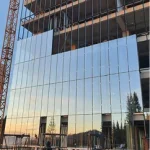
On countertops, for example, a film-based design would degrade quickly from contact with hot pans or cleaning products; ceramic printed glass performs just as well as standard toughened glass, keeping the design intact for years. For commercial cladding — reception areas, storefront facades, exterior branding panels — ceramic printing allows a logo or visual identity to be built directly into the material, without the risk of sun or rain affecting its appearance over time.
We produce these pieces to order, with no minimum quantity and no additional tooling costs, which makes the solution accessible for a single kitchen countertop as much as for a commercial project with dozens of panels.
How to choose the right solution for your project
For a temporary project, a limited budget, or a surface with low exposure, decorative film can be a reasonable solution. For a matte, uniform look with no complex design requirements, sandblasting covers the need. But for any surface exposed daily to sun, handling, or wear — facades, commercial cladding, countertops, decorative glass doors — ceramic printing is the investment that justifies its higher cost through a much longer lifespan.
Frequently Asked Questions
Does ceramic printed glass fade over time, in the sun?
No — the pigment is fused with the glass during tempering, not applied on top, so it withstands UV exposure without losing color intensity.
Can ceramic printing be applied to glass that’s already installed?
No, the process requires the glass to go through the tempering furnace after printing, so it can only be applied to new, freshly processed glass.
What’s the real price difference between ceramic printing and film?
Ceramic printing costs more upfront per square meter, but doesn’t require periodic replacement — unlike film, which degrades over time and adds recurring costs.
Can ceramic printing be done for a small order, like a single countertop?
Yes, we have no minimum order and no tooling costs, so it’s just as accessible for a single piece as for a large commercial project.
How much does a cladding panel or countertop with ceramic printing cost?
Price depends on the surface area, design complexity, and the base glass type used. We provide an exact price once we’ve reviewed the project’s requirements.